
A Private Label Home Fragrance Line, Stage by Stage
A private label home fragrance line moves through eight stages, and each stage ends with something frozen: a range definition, a base decision, an approved sample, a released specification, a test report, a production plan. Programmes that run late are usually programmes where a stage was skipped and a later stage had to absorb it. The sequence is the same whether the work is done with a local filler or with a large partner; only the durations change.
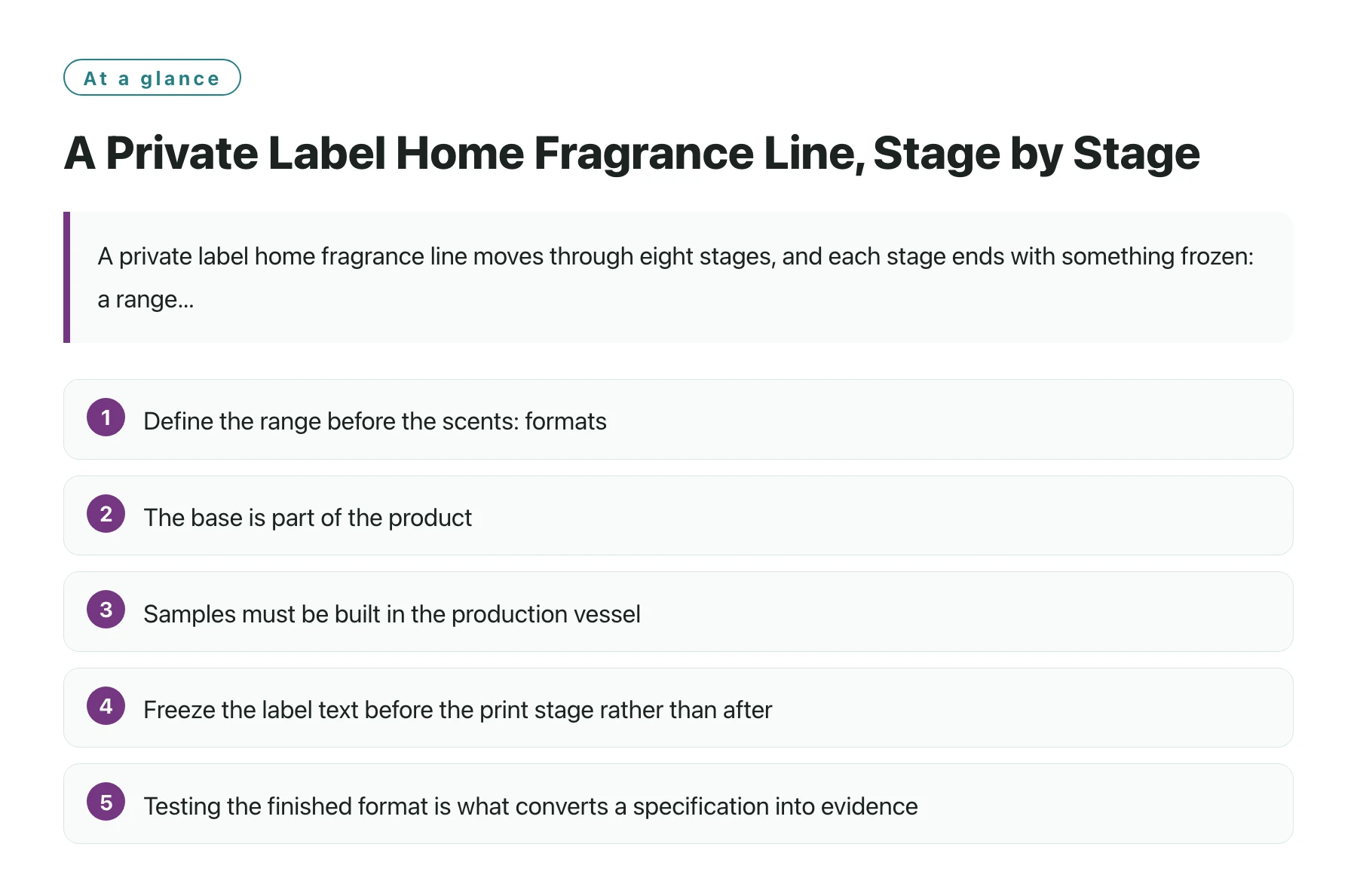
Key takeaways
- Define the range before the scents: formats, number of SKUs and price ladder decide every later cost.
- The base is part of the product, so a candle, a diffuser and a spray each need their own development and testing, even when they share a scent family.
- Samples must be built in the production vessel, with production components, or approval means very little.
- Freeze the label text before the print stage rather than after; translation and proofing take longer than most launch calendars assume.
- Testing the finished format is what converts a specification into evidence, and it should be scheduled as a stage rather than squeezed between stages.
- Plan the second order while the first is in production, because component repeat orders and refill decisions follow the same specification.
Home fragrance programmes are often described as fragrance projects with different packaging. In practice the base, the container and the release mechanism make this a category with its own stage logic.
This is the sequence, written for the person running the programme, with the freeze point at the end of each stage.
The eight stages
- Range definitionChoose the formats, the number of scents, the price ladder and which components will be shared across the range. Freeze the range before any development starts.
- Scent direction and base selectionAgree the olfactive directions and the base for each format: wax, diffuser base or spray base. Freeze the base before sampling.
- Prototype in the production formatBuild samples in the intended vessel with the intended wick, collar or actuator, so the sample behaves like the future product.
- Approval and retained referenceApprove a physical sample in writing, seal a reference at both ends and record the date and storage conditions.
- Specification and artwork releaseSign the specification covering fill, components, tolerances and labelling, then release final artwork and the full label text to print.
- Testing and documentationRun compatibility, stability and safety-related checks on the finished unit, and assemble the market documentation for each destination.
- Bulk, filling and kittingProduce the base, fill the units, apply decoration and assemble the range, with an inspection against the retained reference.
- Delivery and repeat planningShip with batch records, then confirm component repeat orders, refill specifications and the review date for the next range.
Where the calendar actually goes
Fragrance development is rarely the longest stage. Component lead times and print runs are, followed by the testing window on the finished format. Both run on other people's schedules: a print house has a queue, and a test on a filled candle or diffuser takes the time it takes.
The stage that most often disappears from the plan is documentation. Market paperwork, labelling text and test reports are treated as an output of production when they are in fact inputs to it — production cannot be labelled and shipped without them.
Stages that can run in parallel
Component ordering, artwork preparation and label translation can all proceed while the sample is being approved, provided the specification they depend on is already frozen. Programmes that run components in parallel gain weeks; programmes that wait for scent approval before sourcing a vessel lose exactly those weeks.
What cannot run in parallel is testing on the finished format, because it needs the actual base, vessel and fill weight. Schedule it as a stage, not as a delay.
What should be frozen at each gate
Range definition freezes formats and SKU count. Base selection freezes the technical path. Sample approval freezes the product. Specification and artwork release freeze what will be printed. Testing freezes the claims that can be made. Production freezes the components. Skipping a gate does not remove the decision; it moves it later, when it is more expensive.
A useful habit is to keep one document that lists every frozen item with its date. When something changes, the document shows what the change invalidates, which is usually more than the person requesting it expected.
Compliance runs across the whole sequence
Material restrictions depend on how a product is used and dispersed, so the compliance question belongs to the base and format decision rather than to the end of the project [1]. Testing the finished unit, rather than the concentrate alone, is what produces evidence that a specification has been met [2].
Choosing the partner for the sequence
The stage logic does not change with the supplier, but the number of handovers does. A programme run with the perfume factory in Guangzhou and a programme run with a local filler follow the same eight stages; the difference is whether development, base preparation, filling and packing sit in one quality system or are passed between companies with a document at each boundary.
A partner that provides their OEM/ODM manufacturing services across those stages will usually be able to give one critical path rather than four, which makes the freeze points easier to hold. Where the work is split, each boundary needs its own specification and approval, and each one adds a place for the programme to stall.
Length of experience is a reasonable tiebreaker when two suppliers look otherwise similar, because the difficult knowledge in this category is practical: which vessel survives transit, which wick suits a wide jar, which collar seals a refill. A house with a long manufacturing record, such as one with Xuelei's 31 years in fragrance, has usually already met the problems a new range will discover.
Write the eight stages on one page with a target date and a named owner for each. A programme with dates and owners is far easier to protect than a programme managed by chasing.
Sources
- IFRA Standards Library (International Fragrance Association) —— The IFRA Standards Library lists the restrictions the fragrance industry applies to individual fragrance ingredients, based on safety assessments; it is the reference point for compliant fragrance formulation.
- SGS: Cosmetics, Personal Care & Household Testing —— Testing, inspection and certification services for cosmetics and personal care, including microbiological, stability and safety testing aligned with cosmetics GMP.
Frequently asked questions
How many stages can realistically run at once?
Component sourcing, artwork and label translation can run in parallel once the specification is frozen. Development, sampling and finished-product testing cannot be compressed into each other.
Do I need to test every format separately?
Yes, because the finished unit is what the customer uses. A candle, a diffuser and a spray release scent differently and carry different physical risks, even when they share a scent direction.
When should artwork be finalised?
Before the print stage is booked, and ideally before component ordering, so that label dimensions and carton layout are fixed. Artwork changes after plates are made are the most avoidable delay in the sequence.
What belongs in the specification?
Fill weight and tolerance, base and vessel, components including wick or collar, decoration, label text, testing requirements and packing format. Anything not in the specification will be decided by default.
How early should I plan the second order?
While the first is in production. Component repeat orders, refill geometry and any scent additions are cheapest when the specification and tooling are still fresh and unchanged.